Bross - Evaluation and Design of Aluminum-Bronze Cast Components Under the Influence of Manufacturing Conditions and Corrosion

Aluminum-bronze alloys for turbines and ship propellers

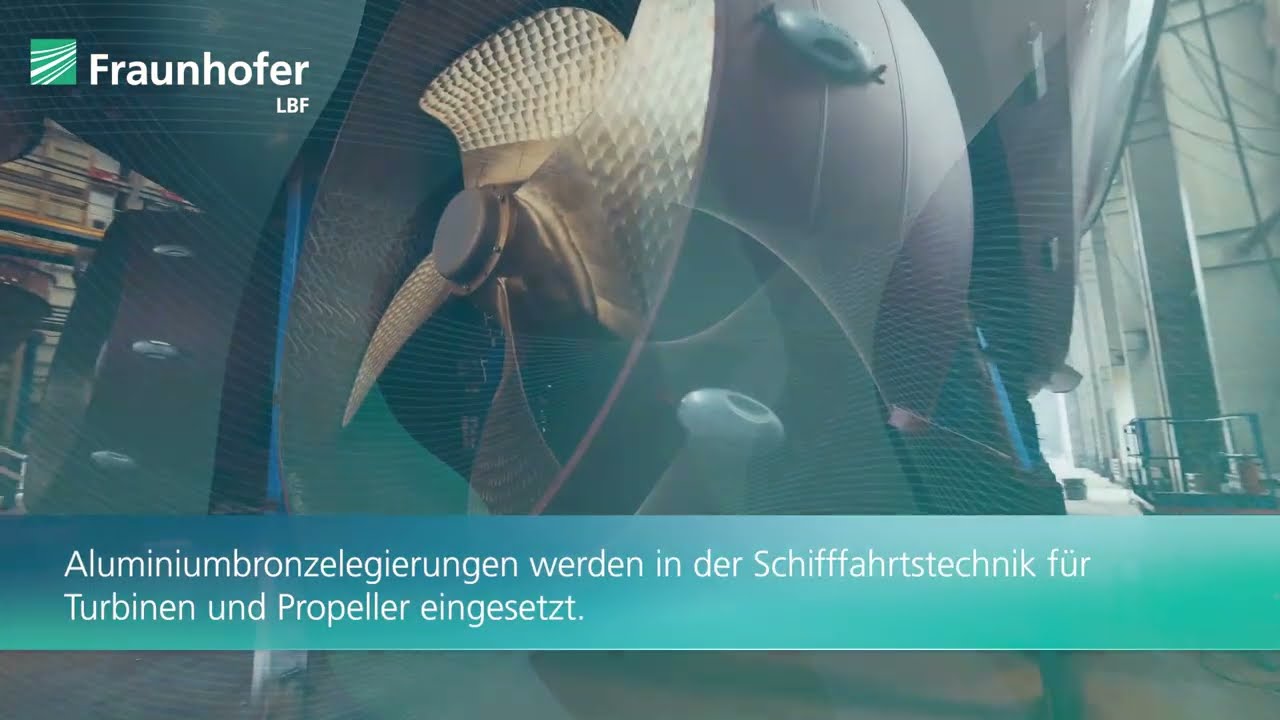
Aluminum bronze alloys (CuAl bronze) are used in hydroelectric and tidal power plants, as well as in marine engineering for turbines and ship propellers. The manufacture of these parts - some of which are very large - places high demands on the casting process, particularly with regard to defects, material properties, and corrosion behavior. Process parameters such as cooling rate, alloy composition, and moisture content - depending on the part geometry and wall thickness - significantly influence the resulting material properties and the parts’ ability to withstand stress.

How can the various influencing factors be taken into account in the design of components? The goal is to ensure the reliable and failure-free operation of marine components - even when individual influencing factors vary.

Aluminum Bronze Alloys for Turbines and Ship Propellers

Aluminum bronze alloys (CuAl bronze) are used for turbines and ship propellers in both renewable energy generation - specifically hydroelectric and tidal power plants - and in maritime ship technology. The production of these parts - some of which are very large - presents foundries with particular challenges regarding defects, material behavior, and corrosion resistance. Process parameters such as cooling rate, alloy composition, and humidity have a significant influence on the final product and its performance capabilities, depending on the part’s geometry. The manufacturing process and the component’s wall thickness thus also determine the resulting material properties.

How can these various factors be taken into account during component design? The goal is to ensure reliable and failure-free operation of maritime components - even when individual factors vary.

aluminiumbronze korrosion meerwasser

Stress Resistance of Thick-Walled Aluminum Bronzes under the influence of local microstructural conditions

As part of the “Bross” research project, the quasi-static and cyclic stress resistance of thick-walled aluminum bronzes for use in ship propellers is being thoroughly investigated. The focus is on evaluating the influence of local microstructural conditions within the propeller. These microstructural conditions result from variations in molding materials, molding material moisture content, and chemical compositions during the casting process and may also include local pores. These influences are examined in detail within the project in terms of their impact on technological parameters and compared with the state of the art. The characteristic values of quasi-static and cyclic material behavior as a function of these technological parameters are then compared with the microstructural parameters determined through metallographic and fractographic analyses.

Wöhlerkurve 25-28 Cu3 Luft+Meerwasser / Aluminiumbronzelegierungen für Turbinen und Schiffspropeller
Wöhler curve 25–28 Cu3 - R = -1 air + seawater - Batches 1, 2, and 7

Effect of Seawater Corrosion

In addition to the effects of microstructural parameters, the superimposed effect of seawater corrosion on cyclic fatigue life is also investigated and correlated with both the microstructural parameters and the component stress. The goal is to describe the mechanisms responsible for corrosion and to identify the material parameters that are decisive for failure under mechanical and corrosive stress in thick-walled aluminum bronzes.

Aktuell werden die experimentell ermittelten Ergebnisse final ausgewertet, fraktographische Analysen der untersuchten Legierungen durchgeführt und der Abschlussbericht erstellt. Als Ergebnisauszug sind im nachfolgenden Wöhlerdiagramm die Schwingfestigkeitsergebnisse an Luft und unter korrosiver Meerwasseratmosphäre dargestellt. Hiermit kann aufgezeigt werden, dass die drei separat abgegossenen Chargen 1, 2 und 7 vergleichbare ertragbare Nennspannungsamplituden aufweisen, weshalb diese auch gemeinsam ausgewertet wurden. Weiterhin kann mit den Ergebnissen aufgezeigt werden, dass der Verlauf der Wöhlerlinie unter Korrosion steiler als an Luft verläuft und sich bei Lebensdauern von 100 Millionen Schwingspielen noch kein Abknicken der Wöhlerlinie andeutet. Diese Erkenntnis ist sehr wichtig für die Auslegung von Schiffpropellern, um deren Zuverlässigkeit über die geplante Nutzungsdauer sicher zu stellen.

Privacy warning

With the click on the play button an external video from www.youtube.com is loaded and started. Your data is possible transferred and stored to third party. Do not start the video if you disagree. Find more about the youtube privacy statement under the following link: https://policies.google.com/privacy

Funding

The Bross research project will run for 3 years and is funded by the German Federal Ministry for Economic Affairs and Climate Action (BMWK).