GJSlim - Digital twin for ultra-lightweight, reliable cast structures

Investigation of the cyclic load-bearing capacity of thin-walled cast components - which can now be produced for the first time

GJSlim is developing a comprehensive, data-driven validation approach for heavily loaded thin-walled cast structures - ranging from process simulation and local material properties to structural durability.

We have been working on the development of a transferable lightweight design concept to leverage increased cyclic load-bearing capacity for ultralight structures made of ductile iron (GJS) with wall thicknesses less than 5 millimeters. The results enable the integration of wall-thickness-dependent design and process optimization with local component properties. The explicit knowledge from the disciplines of foundry engineering, lightweight structural design, and structural durability -captured in the digital twin - enables us to further increase the lightweight design potential of these materials and significantly reduce CO2 emissions during production and use.

High component complexity at low production costs

Cast structures offer high component complexity at low production costs and are therefore ideally suited for the mass production of functionally integrated lightweight structures. In particular, ductile iron (GJS) offers an optimal combination of adjustable strength, ductility, and stiffness for lightweight construction. However, according to the current state of the art, locally varying material properties of GJS components—for example, due to differences in wall thickness—are not taken into account, or only to a very limited extent, in component design.

For this reason, the German Federal Ministry for Economic Affairs and Energy (BMWE) is funding the “GJSlim” project to facilitate the creation of particularly thin GJS structures with wall thicknesses less than 5 millimeters and to determine the effects of scale on component design. The result enables designers of GJS components to use a digital twin to achieve the goals of maximum material and structural utilization while simultaneously reducing CO2 emissions. The diverse expertise required from the disciplines of foundry engineering, lightweight structural design, and structural durability is reflected in the composition of the consortium.

GJSlim - Digitaler Zwilling für ultraleichte, zuverlässige Gussstrukturen
Digitaler Zwilling für ultraleichte, zuverlässige Gussstrukturen
A demonstrator produced as part of the GJSlim project, featuring the first-ever 3-mm-thick thin-walled lightweight structure.
gjslim gussform
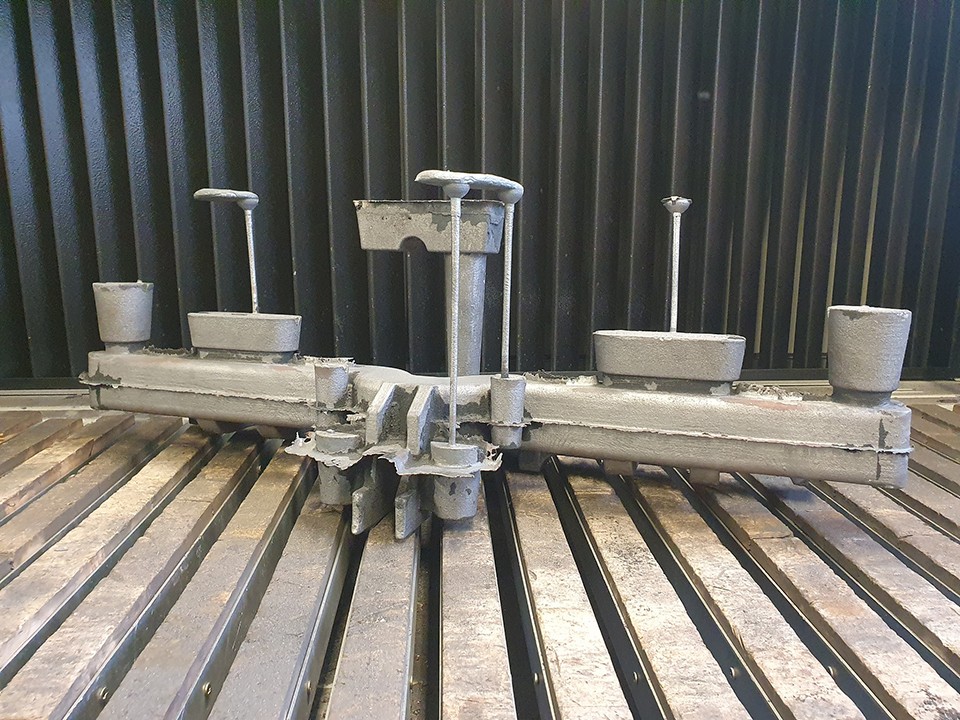
Industrial-quality casting of the demonstrator, including feeders and the sprue/casting system, immediately after demolding.
Geätzter metallographischer Schliff - guss
Etched metallographic section of a 2-mm material specimen showing good nodularity in a ductile ferritic matrix, without the formation of failure-inducing carbides.

Digital validation of highly stressed cast structures

The project team developed a transferable lightweight construction concept that allows thin-walled gray iron (GJS) structures to be safely designed even under increased cyclic loading: We demonstrate how component geometry, the casting process, and local properties are interrelated, and consolidate the explicit knowledge from the fields of foundry engineering, lightweight structural design, and structural durability into a digital twin. This digital twin links manufacturing parameters, locally varying microstructures, component design, and the resulting stress capacity with data from manufacturing, simulation, and loading to achieve a better estimation of material behavior and service life.

First, we are determining under which conditions very thin-walled gray cast iron (GJS) structures can be cast reliably. The focus is on wall thicknesses of less than 5 millimeters. These pose special challenges both in terms of casting technology and in the design for cyclic loading. Suitable mold materials and coatings are selected, and process windows are defined. This promotes a stable surface and prevents the formation of undesirable defects, such as carbides. Building on this foundation, researchers from the project partner INTES further developed methods for topology and shape optimization to account for varying wall thicknesses, local load-bearing capacity, and manufacturing constraints.

We used simulated microstructural states, compared them with experimentally determined findings, and thereby demonstrated the influences of microstructure and solidification time on the local cyclic load-bearing capacity of components. Only with an optimized service life estimation - which can be performed using a newly developed design concept - will it be possible to implement safe and reliable ultralightweight structures.

Funding and partners

This research project is funded by the BMWK pursuant to a resolution of the German Bundestag as part of the Technology Transfer Program for Lightweight Construction (TTP Leichtbau).

More information on the research project “Development of a Transferable Lightweight Construction Concept for Utilizing Increased Cyclic Load Capacities of Thin-Walled GJS Structures Using a Digital Twin – GJSlim”: GJSlim - RWTH Aachen University Institute for Structural Mechanics and Lightweight Construction

From Research to Your Application

How can structures under load be designed to be lighter, more reliable, and more resource-efficient all at once? We develop methods for a holistic analysis of material properties, manufacturing influences, and real-world operational loads to design such structures with precision and reliability.

Our focus is on digital twins that integrate material, process, and operational data, thereby enabling a well-founded assessment of load-bearing capacity, service life, and lightweight design potential.

Our services include, in particular:

  • Development of digital twins for load-bearing structures and components
  • Assessment of structural durability and service life under real-world loads
  • Coupling of material, process, and structural simulations
  • Optimization of resource- and weight-efficient components

👉 Our services address applications in lightweight construction and the design of heavily loaded structures - from mobility and mechanical engineering to energy and industrial applications. Contact us!

Research & Development

Key scientific and technological areas


  • Analysis and Evaluation of Components and Materials

Department Engineered Materials and Components


  • Reliability Engineering for Systems

Department System Reliability


Projects

Our project experience

Model-based research and development


R&D-Services and Research Topics

Digital Twins & Simulation

Digital Twins and Numerical Simulation - The Key to Efficient Product Development