Integration into Elastomer Components
The sensor elements produced using this process were subsequently integrated into various elastomer components as prototypes. This made it possible to develop sensor-integrated machine mounts and couplings, which were ultimately tested in a real-world operating environment in collaboration with the participating industry partners. The experience gained here shows that integrating sensor elements into elastomer components requires innovative approaches and thorough preliminary investigations to achieve the desired functional results and overcome the challenges of each specific application.
Validated and Scalable Manufacturing Technology for Delta-C© Sensors
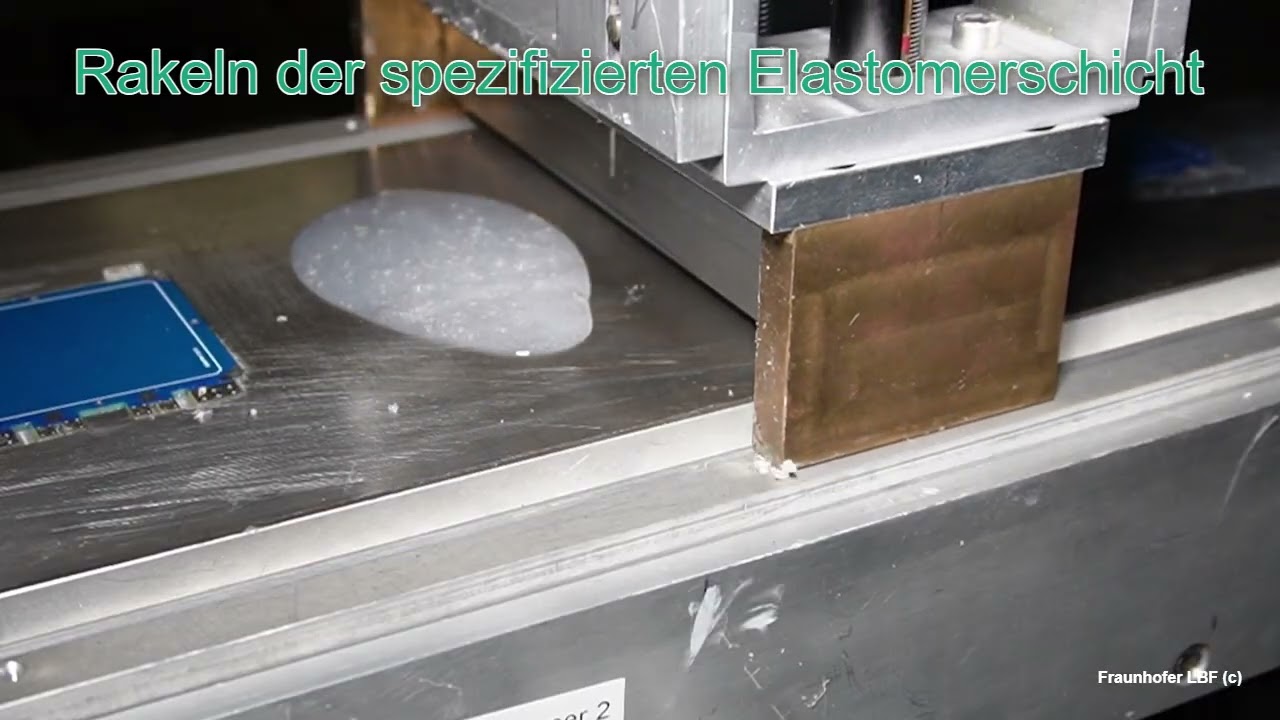
In the DELIGHT research project, a production line at Fraunhofer LBF is therefore being retrofitted to provide a validated and scalable manufacturing technology for Delta-C© sensors in the load range from 10 N to 6 kN. The sensor elements are assembled step-by-step on a rigid or flexible substrate, onto which the elastomer is alternately spread and the electrodes positioned. Depending on the required sensor properties, this creates a layered composite that can be integrated into industrial elastomer components. The previously used precision-etched—and thus cost-intensive—structured metal electrodes were replaced in the manufacturing process with a cost-effective metal mesh laminated on one side. Automated manufacturing also improved the reproducibility of the sensor elements, enabling structured investigations into various design and manufacturing parameters.
At the conclusion of the project, the technology is scheduled to be demonstrated in functionally integrated elastomer components in real-world operating environments.
Funding Bodies and Partners
- AiF Research Network for Small and Medium-Sized Enterprises
- German Federal Ministry for Economic Affairs and Climate Action (BMWK)
The DELTA-C sensor technology is based on this patent: Kaal, W.; Herold, S.; Melz, T.: Electroactive Elastomer Transducer, Patent EP 2630674